Why Racing Teams, Off-Road Enthusiasts, and Performance Drivers Choose PTFE Brake Lines
What Are PTFE Brake Lines?
If you’ve ever pushed your vehicle hard—whether on a racetrack, mountain trail, or during spirited driving—you know how critical reliable braking is. Standard rubber brake hoses, while adequate for everyday driving, have limitations that become apparent under demanding conditions. This is where PTFE brake lines come in.
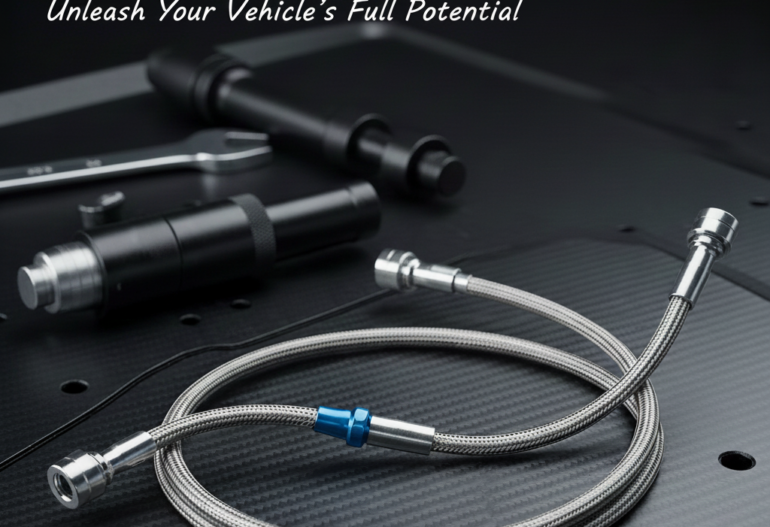
PTFE (Polytetrafluoroethylene), commonly known by the brand name Teflon, is a high-performance fluoropolymer with exceptional chemical resistance and thermal stability. When used as the inner lining of brake hoses—typically wrapped in stainless steel braiding for durability—PTFE creates brake lines that outperform conventional rubber in virtually every measurable way.
Key Benefits of PTFE Brake Hose
1. Superior Heat Resistance
PTFE maintains its structural integrity at temperatures up to 260°C (500°F), far exceeding the capabilities of rubber hoses. During aggressive braking, caliper temperatures can soar—particularly in motorsport applications or while descending steep mountain roads. Rubber hoses soften and expand under such heat, creating a spongy pedal feel. PTFE remains dimensionally stable, ensuring consistent brake response when you need it most.
2. Virtually Zero Expansion Under Pressure
When you press the brake pedal, hydraulic fluid transmits force through the brake lines to your calipers. Rubber hoses flex and expand under this pressure, absorbing some of the hydraulic force before it reaches the calipers. PTFE brake lines, reinforced with stainless steel braiding, resist expansion almost entirely. The result? A firmer, more direct pedal feel and improved modulation—you can feel exactly how much braking force you’re applying.
3. Chemical and Corrosion Resistance
PTFE is chemically inert, meaning it won’t degrade when exposed to brake fluid, road salt, petroleum products, or other contaminants. The stainless steel outer braiding provides additional protection against physical abrasion and environmental corrosion. This combination makes PTFE brake lines particularly valuable in harsh conditions—from salt-laden winter roads to dusty off-road trails.
4. Extended Service Life
While manufacturers typically recommend replacing rubber brake hoses every 4-6 years due to age-related deterioration, quality PTFE brake lines can last significantly longer. Their resistance to heat cycling, UV exposure, and chemical attack means they maintain performance characteristics over extended periods, offering long-term value despite higher initial costs.
Real-World Performance: ASHVA 4X4 Case Study
The benefits of PTFE brake hoses aren’t just theoretical—they’re proven in demanding real-world applications. A compelling example comes from India’s first indigenous Side-by-Side Vehicle (SSV), the ASHVA 4X4, developed by A-THON All Terrain.
When A-THON’s engineering team designed the ASHVA to conquer extreme terrain, they selected Advanced Fluro’s PTFE brake hoses as a critical safety component. The reasoning was clear: a vehicle designed for steep gradients, rock crawling, and aggressive off-road manoeuvres demands braking performance that rubber simply cannot deliver.

The ASHVA 4X4—India’s first Side-by-Side Vehicle—featuring brake lines powered by Advanced Fluro PTFE hoses.
First public display in Mumbai, Maharashtra.
The ASHVA 4X4 represents the kind of application where PTFE brake hoses truly shine. Off-road vehicles face unique braking challenges: extreme heat build-up during long descents, exposure to water, mud, and debris, and the need for precise brake modulation when navigating technical terrain. In these conditions, the consistent performance of PTFE provides a genuine safety advantage.
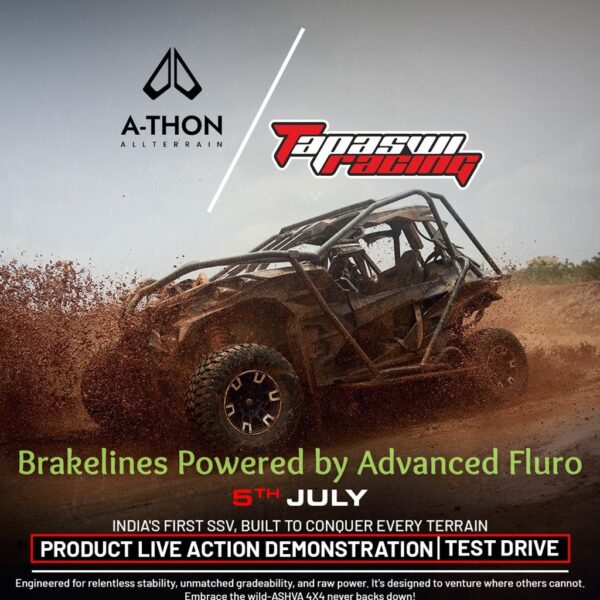
ASHVA 4X4 during live product demonstration at Tapasvi Racing, Wagholi, Pune.
The vehicle’s braking system—equipped with Advanced Fluro PTFE hoses—is tested under demanding off-road conditions.
Who Should Consider PTFE Brake Lines?
PTFE brake hoses aren’t necessary for every driver, but they offer substantial benefits for specific applications. Consider upgrading if you fall into any of these categories:
Track Day Enthusiasts and Racers: Repeated hard braking generates extreme heat. PTFE’s thermal stability prevents the pedal fade that rubber hoses can exhibit after multiple hot laps.
Off-Road and Overlanding Vehicles: Like the ASHVA 4X4, vehicles designed for trail use benefit from PTFE’s durability and consistent performance across varying conditions.
Mountain Driving: Long descents with continuous braking push rubber hoses to their limits. PTFE maintains firm pedal feel throughout.
Performance Vehicle Owners: If you’ve upgraded pads, rotors, or calipers, rubber hoses become the weak link in your braking system.
Towing and Heavy-Duty Applications: Increased vehicle weight means increased braking demands. PTFE lines help maintain stopping performance under load.
Signs Your Brake Hose Need Replacement
Whether you’re upgrading to PTFE or simply replacing worn rubber hoses, watch for these warning signs:
Spongy or inconsistent pedal feel: If your brake pedal feels soft or the firmness varies, expanding hoses may be the culprit.
Visible cracking or bulging: Rubber deteriorates over time. Any visible damage indicates immediate replacement is needed.
Brake fade under hard use: If braking performance diminishes during spirited driving, heat-related hose expansion may be contributing.
Age: Rubber hoses over 6 years old should be inspected carefully, regardless of appearance.
Installation Considerations
Installing PTFE brake lines is a straightforward process for experienced mechanics, though brake system work should always be performed by qualified professionals. Key considerations include:
Proper routing: PTFE lines are less flexible than rubber. Ensure the routing allows for full suspension travel without stretching or kinking.
Fitting compatibility: Verify that the brake line fittings match your vehicle’s caliper and master cylinder connections.
Complete bleeding: Thoroughly bleed the brake system after installation to remove all air bubbles.
Quality sourcing: Purchase from reputable manufacturers. Brake components are critical safety items—this is not the place to cut corners.
Making the Upgrade
PTFE brake hoses represent a meaningful upgrade for drivers who demand consistent, reliable braking performance. While they carry a higher upfront cost than rubber alternatives, their superior heat resistance, minimal expansion, and extended durability make them a worthwhile investment for performance-oriented applications.
The choice of PTFE brake lines by A-THON for India’s first indigenous SSV underscores the technology’s real-world value. When engineering a vehicle to handle extreme terrain and demanding conditions, the team recognized that standard components simply wouldn’t suffice.
For drivers seeking the same level of braking confidence—whether on the track, trail, or mountain road—PTFE brake hoses offer a proven path to improved performance.
Advanced Fluro Pvt Ltd manufactures precision PTFE brake hoses for automotive, motorsport, and industrial applications.
Contact us at aftubes.com for custom specifications and bulk enquiries.