In the heavy industry of steel profile manufacturing, the margin for error is non-existent. Precision is required not just for the dimensions of the steel, but for the integrity of the chemical and thermal processes that define its quality. Recently, a prominent steel manufacturer learned a painful lesson in industrial procurement: when it comes to critical components, the “cheaper” option can become the most expensive mistake in a company’s history.
This is the story of how a sub-par PTFE (Polytetrafluoroethylene) tube choice led to a catastrophic system failure, a 25-lakh purification bill, and a serious environmental crisis—and how expert intervention eventually saved the operation.
The Fatal Flaw: Material Mismanagement
The heart of the company’s pickling line—the process where steel profiles are cleaned of oxides and scale—relies on a high-efficiency heating unit. To maintain the acid bath at the precise temperature required for chemical activation, the company used a heat exchanger system. This system involves circulating hot thermic fluid through tubes submerged in a highly corrosive environment.
In an ill-advised attempt to optimize capital expenditure, the procurement team opted for low-quality, generic PTFE tubing for these heating coils. While PTFE is theoretically known for its chemical inertness, the molecular integrity of the material varies wildly between manufacturers.
The Incident: Rupture and Contamination
The failure occurred during a high-output production cycle. The generic PTFE lacked the necessary properties to withstand the dual-pressure of:
- Chemical Attack: The aggressive pickling acid (typically a mix of Hydrochloric acid, HCl, or Sulfuric acid, H2SO4) began to permeate the low-grade material.
- Thermal Stress: As the internal thermic fluid reached peak operating temperatures, the weakened tube walls could no longer contain the pressure.
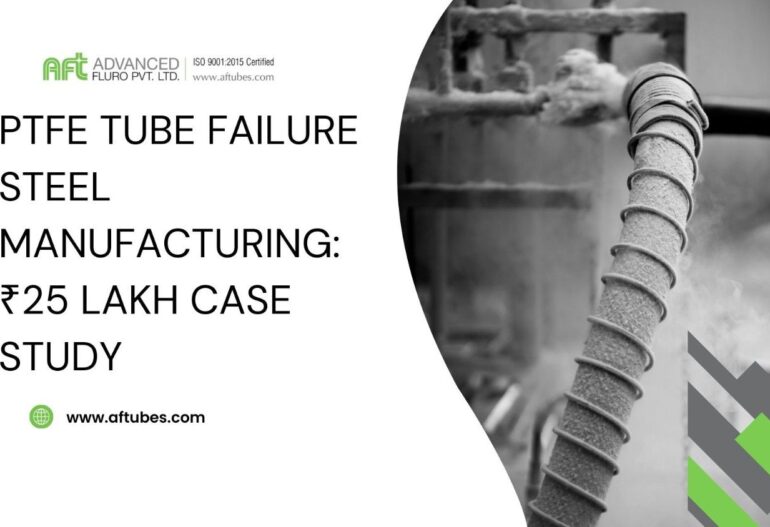
The tubes ruptured violently, allowing the oil-based thermic fluid to erupt into the acid tank. The two substances mixed instantly, creating a contaminated chemical slurry that was effectively useless for steel processing.
The Impact: A 25-Lakh Crisis
The consequences of this failure rippled through the entire organization, resulting in a three-pronged disaster:
- Financial Loss: The company was forced to spend 25 lakhs on specialized chemical purification services just to salvage the acid and clean the tanks. This does not include the cost of the lost thermic fluid or the replacement of the ruined heating units.
- Environmental & Regulatory Issues: The leak posed a severe environmental threat. Mixing industrial oils with concentrated acids creates a hazardous waste nightmare that requires stringent containment. The incident triggered an internal environmental audit and risked heavy fines from regulatory bodies.
- Operational Paralysis: The resulting downtime meant the company missed critical product delivery targets. In an industry where “Just-In-Time” delivery is standard, this damaged long-standing client relationships and incurred heavy late-delivery penalties.
| Impact Category | Consequence |
| Direct Cost | 25 Lakhs for acid purification |
| Operational | Total production line shutdown |
| Supply Chain | Missed delivery targets and client penalties |
| Environmental | Serious hazardous waste mismanagement risk |
The Turning Point: Advanced Fluro & DuPont (Now Chemours)
Recognizing that they could not afford another failure, the manufacturer reached out to the specialists at Advanced Fluro.
The Advanced Fluro team performed a deep-dive analysis of the failure. They concluded that standard “off-the-shelf” PTFE was insufficient for the extreme thermal gradients and chemical concentrations of this specific pickling tank. They immediately consulted the laboratory experts at DuPont (Now Chemours), the global leaders in fluoropolymer science.
By leveraging the material science databases of DuPont (Now Chemours), the team identified a specific grade of high-performance Teflon™ PTFE. This material was engineered for:
- Extreme Permeation Resistance: Ensuring acid molecules cannot migrate into the tube wall.
- Thermal Integrity: Maintaining structural strength even at the high temperatures required by the thermic fluid.
- Stress-Crack Resistance: Handling the constant expansion and contraction of industrial heating cycles.
Conclusion: Quality as a Strategic Investment
Since the installation of the DuPont (Now Chemours) specified tubes by Advanced Fluro, the company has reported zero leaks and zero unplanned downtime.
The lesson is clear: The integrity of a manufacturing process is only as strong as its weakest component. While high-quality PTFE carries a higher initial price tag, it is a fraction of the cost of a 25-lakh cleanup and a tarnished reputation. True industrial efficiency lies in reliability, safety, and the peace of mind that comes from using materials engineered specifically for the task.