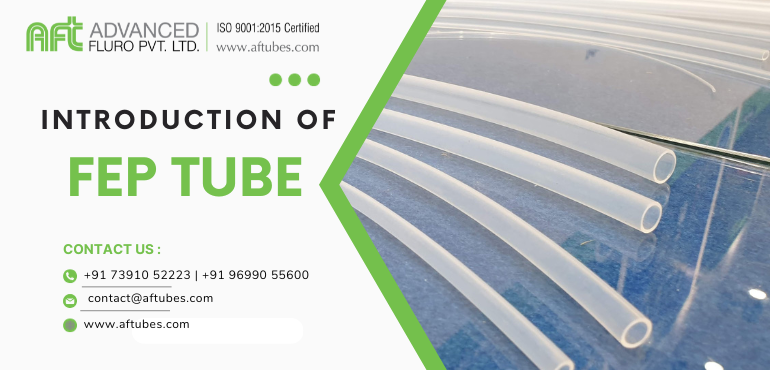
FEP stands for Fluorinated Ethylene Propylene and thin wall flexible tubes made from FEP resin are called FEP tubes. They are naturally transparent.
FEP Tubes in Industrial
In fact they are so transparent that they allow more than 90% of light to pass through. Making these tubes ideal for applications which require glass like transparency. UV light as used in water treatment. The UV lights are submerged in water and have high intensity. The high intensity of the UV lights kills the bacteria in the water and purifies the water. The UV lights are made of glass and are prone to breakage. The UV lights are not only used to purify water but many other liquids like in a effluent treat plant. The liquids in and effluent treat plant can have solid particles that can break the glass UV lights rending them inoperable. The UV lights are therefore covered with transparent FEP tubes to provide them protection from solid particles.
Applications Beyond Water: Liquid Colors
There are applications involving liquid colours where tubes carrying the colours need to be transparent so the colour can be identified visually. Industrial printers have FEP tubes that carry coloured inks from their respective tanks to the printing head. Industrial printers generally used MEK based ink.
MEK is a chemically aggressive chemical and its compatibility with polymers like PE, PP & PVS is very poor. FEP tubes due to their transparency and universal chemical inertness are preferred tubing for this application. The printing inks are sprayed at high pressures. FEP tubes have excellent tensile strength and hence high working pressure, another plus point for this application.
Painting with Precision: The Role of FEP Tubes in Paint Robots
Another similar application in which FEP tube is used is that paint robot. Paint robots are highly automated systems for painting metal parts in bulk quantities. An example is that of painting automobiles bodies. Paint is supplied to the robots from paint tanks. The paint colour changes after every few batches. The FEP tube paint line is then purged and cleaned by passing a industrial solvent through it. The transparency of the FEP tube and its excellent chemical inertness proves to be a perfect fit in this application. The paint is generally mixed with a hardner, the low coefficient of friction ensures that the hardner does not readily stick to the inner bore of FEP tube increasing the life of these in the paint line.
FEP Tubes in Analytical Instruments
FEP tubes are widely used in analytical instruments as they are can be easily moulded in shapes. Some of the popular shapes that
FEP tubing is available in different colours like red, blue, green, yellow, black, green, etc. FEP tubing is also available in different thicknesses such as 0.5 mm, 0.75 mm, 1 mm, and 1.5 mm. Standard sizes are ID2xOD3, ID2xOD4, ID4xOD6, ID6xOD8, ID8xOD10, etc, dimensions are in millimeters. FEP tubing is also available in imperial sizes such as 1/32×1/16, 1/16×1/8, 1/8×3/16 etc, dimensions are in inches. FEP tubes are available in continuous lengths of 25, 50, & 100 meters.
Advanced Fluro has been in the Fluoropolymer tubing business since 2011 and supplies world-class quality of Fluoropolymer tubes including FEP tubing.
FAQ’S
1. What are FEP tubes and why are they used in industrial applications?
FEP (Fluorinated Ethylene Propylene) tubes are transparent, chemically resistant, and flexible tubes made from FEP resin. They are widely used in industries for applications requiring chemical compatibility, UV resistance, and visual fluid inspection.
2. How are FEP tubes used in UV water treatment systems?
In UV water purification systems, FEP tubes act as protective sleeves for UV lamps. Their high transparency (over 90% light transmission) allows effective UV exposure while shielding fragile glass bulbs from solid particles in water or effluent treatment plants.
3. Why are FEP tubes preferred for industrial printing and ink handling?
FEP tubes are ideal for industrial printing because they are compatible with aggressive chemicals like MEK-based inks, offer high pressure resistance, and maintain clarity for monitoring ink color. Their inert nature prevents chemical reactions and clogging.
4. What makes FEP tubes suitable for automated paint robots?
FEP tubes are used in paint robots due to their transparency, chemical resistance to solvents and hardeners, and low coefficient of friction. This prevents paint residue buildup, increases tube life, and allows efficient cleaning during color changes.
5. Can FEP tubes be used in analytical instruments?
Yes, FEP tubes are commonly used in analytical instruments because they are easily moldable, chemically inert, and available in various sizes and colors. These properties make them ideal for precise fluid handling and sample integrity.
6. What sizes and colors are available for FEP tubing?
FEP tubing is available in various metric and imperial sizes, including ID2xOD3 mm to ID8xOD10 mm, and 1/32×1/16” to 1/8×3/16”. They come in standard lengths (25, 50, 100 meters) and multiple colors such as red, blue, green, yellow, and black.