When selecting the right PTFE hose for your industrial application, understanding the differences between smooth bore vs convoluted PTFE hose is essential for optimal performance and cost-efficiency. Both types utilize polytetrafluoroethylene (PTFE) as their core material, offering exceptional chemical resistance and temperature tolerance, but their internal construction creates distinct advantages for different applications. Whether you’re transferring aggressive chemicals, pharmaceutical ingredients, or food-grade materials, choosing between a smooth bore PTFE hose and its convoluted counterpart can significantly impact flow rates, cleaning efficiency, and overall system performance.
What is PTFE Hose?
PTFE hose is a flexible tubing solution made from polytetrafluoroethylene, a synthetic fluoropolymer known for its outstanding chemical inertness and non-stick properties. These hoses are designed to handle extreme temperatures ranging from -65°F to 450°F (-54°C to 232°C) while resisting virtually all industrial chemicals, solvents, and corrosive substances.
Smooth Bore PTFE Hose: Design and Features
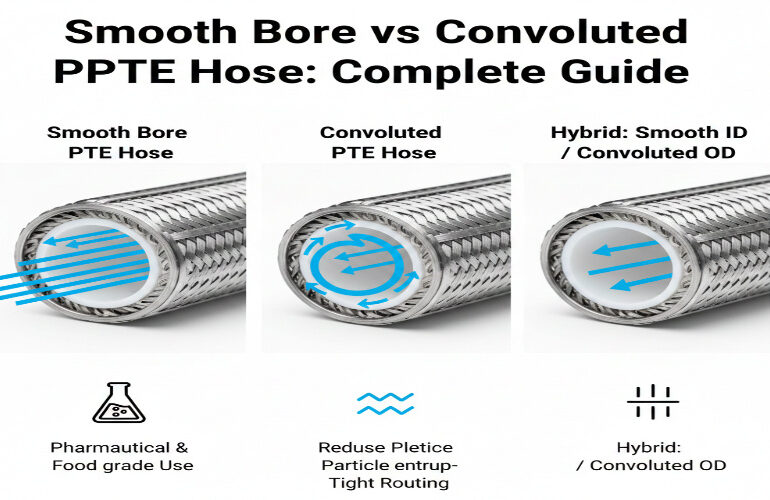
Smooth bore PTFE hose features a seamless, uniform inner diameter throughout its length, creating an uninterrupted pathway for fluid transfer.
Construction Characteristics
The manufacturing process involves extruding PTFE into a perfectly smooth tube, which is then typically reinforced with stainless steel braiding or other external support layers. This creates a rigid yet flexible structure that maintains its internal smoothness under pressure.
Key Advantages
Superior Flow Efficiency: The smooth internal surface minimizes friction, allowing for maximum flow rates and reduced pressure drop across the hose length.
Hygiene and Cleanability: With no ridges or grooves to trap particles, smooth bore hoses are significantly easier to clean and sanitize, making them ideal for applications requiring strict hygiene standards.
Reduced Contamination Risk: The seamless interior prevents material buildup, bacterial growth, and cross-contamination between batches.
Better for Viscous Fluids: High-viscosity materials flow more easily through smooth passages without getting trapped in surface irregularities.
Ideal Applications
Smooth bore PTFE hoses excel in pharmaceutical manufacturing, food and beverage processing, biotechnology, cosmetics production, and any application where purity, cleanability, and unobstructed flow are paramount.
Convoluted PTFE Hose: Design and Features
Convoluted PTFE hose has a corrugated or ridged inner surface, creating a series of waves along the tube’s interior.
Construction Characteristics
The corrugated design results from the manufacturing process where PTFE is formed around a mandrel, creating the characteristic wave pattern. This construction method is typically less expensive to produce than smooth bore alternatives.
Key Advantages
Enhanced Flexibility: The corrugated structure allows for tighter bending radiuses without kinking or collapsing, making installation easier in confined spaces.
Cost-Effectiveness: Generally less expensive to manufacture and purchase compared to smooth bore options.
Better Vacuum Resistance: The ridged structure provides better resistance to collapse under vacuum conditions.
Easier to Route: The superior flexibility allows for complex routing through machinery and tight spaces.
Ideal Applications
Convoluted PTFE hoses work well for general chemical transfer, hydraulic systems, pneumatic applications, and situations where flexibility and cost considerations outweigh the need for absolute smoothness.
Direct Comparison
Flow Performance
Smooth bore hoses deliver approximately 20-30% better flow rates compared to convoluted hoses of the same diameter due to reduced friction and turbulence.
Pressure Drop
The corrugated interior of convoluted hoses creates turbulence that increases pressure drop, requiring more pumping power for equivalent flow rates.
Cleaning and Maintenance
Smooth bore designs clean completely with standard CIP (Clean-in-Place) systems, while convoluted hoses may retain residues in the grooves, requiring more intensive cleaning protocols.
Flexibility and Installation
Convoluted hoses bend more easily and require less space for routing, while smooth bore hoses need larger minimum bend radiuses to prevent damage.
Particle Entrapment
Smooth bore hoses eliminate entrapment concerns, whereas convoluted designs can trap particles, fibers, or product residues in the ridges.
Cost Considerations
Convoluted hoses typically cost 30-40% less than equivalent smooth bore hoses, making them attractive for budget-conscious applications where smoothness isn’t critical.
Selection Criteria
Choose Smooth Bore PTFE Hose When:
- Working with pharmaceutical or food-grade products requiring FDA compliance
- Transferring high-purity chemicals or sensitive materials
- Maximum flow efficiency is required
- Easy cleaning and sanitization are essential
- Preventing contamination is critical
- Handling viscous fluids or pastes
Choose Convoluted PTFE Hose When:
- Budget constraints are significant
- Installation requires tight bends and complex routing
- Operating under vacuum conditions
- Transferring general industrial chemicals
- Absolute smoothness isn’t necessary for the application
- Quick installation in confined spaces is needed
Industry-Specific Recommendations
Pharmaceutical Industry: Smooth bore is the industry standard due to regulatory requirements for cleanability and validation.
Food and Beverage: Smooth bore is strongly preferred for direct product contact to meet sanitary standards.
Chemical Processing: Choice depends on specific chemicals and purity requirements; both types may be suitable.
Semiconductor Manufacturing: Smooth bore is essential for ultra-pure chemical delivery.
General Industrial: Convoluted hoses often provide adequate performance at lower cost.
Maintenance and Longevity
Both hose types offer excellent durability when properly maintained. Smooth bore hoses typically require less frequent replacement in sanitary applications due to easier validation of cleanliness. Convoluted hoses may need more frequent inspection for trapped materials that could degrade or contaminate future transfers.
Regular inspection should include checking for cracks, discoloration, or stiffening in the PTFE liner, as well as examining external braiding for wear or corrosion.
Conclusion
The choice between smooth bore vs convoluted PTFE hose ultimately depends on your specific application requirements. Smooth bore PTFE hoses represent the premium option for applications demanding maximum purity, flow efficiency, and cleanability, particularly in pharmaceutical, food, and biotechnology sectors. Convoluted PTFE hoses offer an economical, flexible solution for general industrial applications where their corrugated structure doesn’t compromise performance.
Consider your priorities regarding flow rates, cleaning requirements, installation constraints, and budget to make the most informed decision. When in doubt, consult with hose manufacturers or application engineers who can evaluate your specific needs and recommend the optimal solution for your operation.